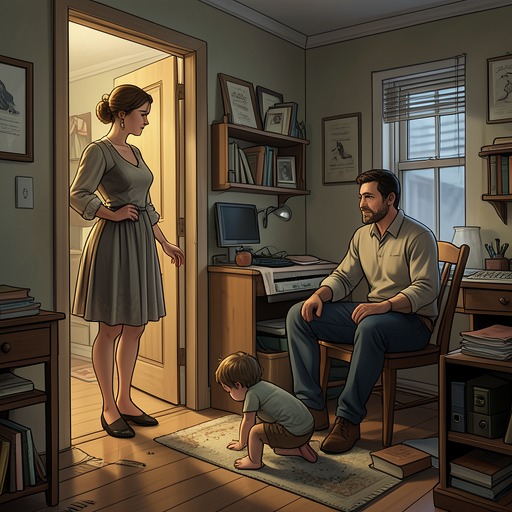
Avery Black's cabin
SCOTTISH ROMANCE: My Sinful Surrender to a Highlander Werewolf (Scottish Werewolf Pregnancy Romance) (Historical Medieval Shape Shifter Paranormal Science Fiction Short Stories)Avery Black's cabin is an off-grid mountain refuge whose isolation governs every encounter within it. Located about five miles from the site where April suffered her fall, it offers immediate shelter, food, heat, electricity, and medical care, but its distance from ordinary society also makes it a place of secrecy and uncertainty. The cabin therefore functions both as a sanctuary and as a potential trap: April is saved there, yet she cannot simply summon help or leave without confronting her injury and Avery Black's guarded past.
Setting and Self-Sufficiency
The cabin is deliberately separated from civilization. Avery Black explains that there is no cell service, landline, or computer, and that he prefers to keep the property off the grid because he enjoys solitude and the absence of a conventional job helps him manage a chronic condition. A generator supplies television, hot water, and enough electricity for one person. This arrangement gives the cabin an almost sealed existence, dependent on Avery Black's ability to maintain it and to travel down to civilization when he needs to renew his prescription.
Its domestic order contrasts with its remoteness. When April finally leaves the bedroom, she finds a hallway decorated with photographs, including a blond woman standing beside Avery Black with the eyes of someone in love. The living room is immaculate and open-plan, with the kitchen immediately visible. Avery Black is behind the stove preparing steak, fresh vegetables he planted and harvested himself, corn, baby carrots, and mashed potatoes. The cabin is not presented as barren wilderness accommodation; it is a carefully maintained household whose warmth and abundance make the absence of outside contact more striking.
April's Rescue and Confinement
April reaches the cabin after a serious accident and wakes in a stranger's bed without clothes, initially uncertain whether she has been rescued or placed in danger. Avery Black has carried her roughly five miles from the site of the fall, recognized that she may have broken her ankle, bandaged the swollen injury, and used one of his remaining morphine injections to reduce her pain. The treatment is practical but limited: he has only a finite supply because he also requires constant injections for his chronic condition.
April's injury makes the cabin's isolation physically consequential. She wants an extraction team and insists that she does not want to be coddled, even standing naked before Avery Black to demonstrate that she is not helpless or ashamed of her body. When she tries to walk in search of food, however, the pain overwhelms the morphine and she stumbles into his arms. The cabin consequently becomes a temporary space in which independence is tested against bodily vulnerability. Avery Black provides clothing, including blue jeans, April's denim shirt, and her clean undergarments, while April chooses the jeans without underwear, treating the choice as an assertion of freedom rather than embarrassment.
Suspicion, Hospitality, and Disclosure
The cabin's hospitality does not erase the threat of surveillance. Avery Black knows April's name because he has examined her identification, which she finds spread across the coffee table. She confronts him and threatens to leave despite her injured foot. Avery Black admits that he is distrustful and suspected she had been sent to find him, so he wanted to know whom he was dealing with. His explanation reveals that the cabin's privacy is not merely a lifestyle preference: it is a defensive structure built around fear of discovery.
The photographs and Avery Black's guarded behavior lead April to ask why anyone would be looking for him. He tells her that he and his fiancée were attacked in an alley, after which he awoke to find her dead and staring at him with cold, dead eyes. The police suspected him of foul play, and because he could not persuade them otherwise, he made himself scarce. The cabin thus holds the aftermath of an unresolved crime as well as the evidence of a lost relationship. Its seclusion protects Avery Black from immediate suspicion, but it also preserves the unanswered question of what happened to his fiancée.
The Cabin as a Site of Supernatural Revelation
The decisive discovery in the cabin comes through Avery Black's body. April notices the intricate dragon tattoo on his shoulder, whose artistry makes it appear almost alive, and later uses a magnifying glass found in a dresser to inspect it closely. She sees two puncture wounds within the tattoo. The detail transforms what first seemed ornamental into the visible mark of a curse, and it gives a supernatural explanation to Avery Black's account of blackouts and the strange aftermath of the attack.
April questions him about waking in unfamiliar places, dreams followed by blood or tissue beneath his fingernails, and the taste of copper in his mouth. She tells him that these experiences are caused by the bite. Avery Black responds with surprise and goes directly to a mirror, turning the cabin from a private refuge into an improvised investigative chamber. The domestic objects within it—a dresser, a magnifying glass, a mirror, a broken chair, and the photographs—become instruments through which the hidden truth is assembled. The revelation reverses the meaning of the cabin: it is not simply where Avery Black hides from the police, but where the nature of his transformation can finally be recognized.
Narrative Significance
Avery Black's cabin concentrates the story's central tensions between safety and confinement, solitude and intimacy, rational explanation and supernatural knowledge. Its stocked kitchen and working generator suggest stability, while the lack of communication technology prevents easy rescue. Its photographs preserve love, its medical supplies expose fragility, and its isolation shields a fugitive whose body carries evidence of something he does not yet understand.
The location also gains significance through contrast with other forms of displacement and danger in the wider narrative. Jake's death leaves grief embedded in clothing, notes, and the empty side of a bed; Aleah's first beating turns a home into a site of domestic terror; Emma's house fire destroys the supposed security of family life; and Opal's flight through rural Arkansas makes every town both a promise of survival and a risk of capture. Against these settings, Avery Black's cabin is unusually double-edged. It offers April food, treatment, clothing, and shelter, yet it cannot offer uncomplicated freedom. The cabin's deepest function is to hold characters at the threshold between rescue and captivity until hidden identities and dangerous histories become impossible to ignore.